AI Programmatic SEO Guide for Startups 2026
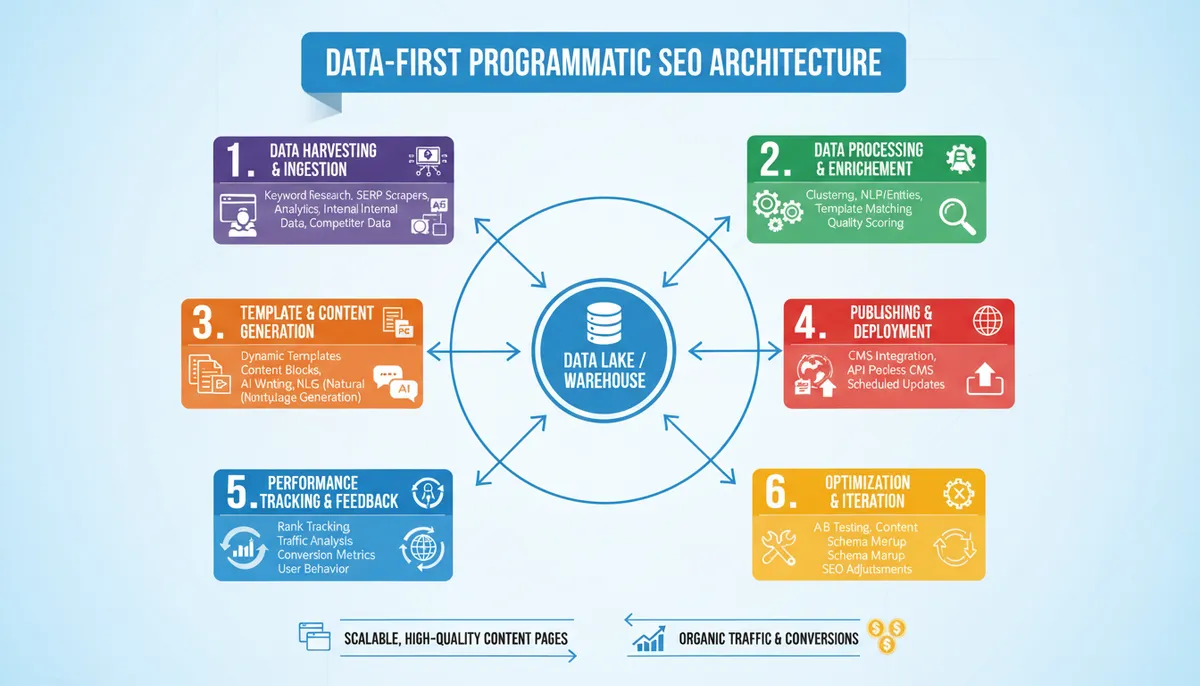
The Ultimate AI-Powered Programmatic SEO Guide for Startups (2026): SaaS, Web3 & High-Impact Traffic
Stop thinking about programmatic SEO as a content farm. That 2018 template-spam approach died with Google's helpful content updates, and good riddance. In 2026, the playbook for SaaS founders and Web3 builders is fundamentally different: It's about engineering autonomous, high-quality content systems that capture long-tail traffic at scale.
We're not talking about generic templates. We're building intelligent pipelines that transform your unique data, customer insights, transaction patterns, or specialized industry knowledge, into genuinely helpful search assets. For ambitious startups, this transforms organic search from a vague marketing channel into your most reliable, predictable revenue engine.
The 2026 Programmatic SEO Framework for SaaS Startups: Scale Without Penalties
Programmatic SEO isn't dead; it's just evolved. While the old 'city pages' and keyword-stuffed UGC templates have been rightfully penalized into oblivion, a new, more powerful framework has emerged. In 2026, scaling from zero to 10K+ organic visits isn't about brute-force publishing, it's about building a sophisticated, AI-augmented, and data-driven content architecture that Google actually rewards. The spammy loopholes are closed, but the opportunity is bigger than ever for founders who understand how to build sustainable traffic assets.
This playbook distills the principles behind Zapier's, Canva's, and Airbnb's SEO dominance into a practical, executable strategy specifically for resource-strapped B2B SaaS startups. We'll cover the modern 'what,' the critical 'why,' and the exact 'how' to build a programmatic traffic engine that generates qualified leads without requiring a massive backlink profile or content team. Stop thinking about content volume and start thinking about systematic relevance.
Is Programmatic SEO Dead in 2026? Why the Old Playbook Broke
No, programmatic SEO isn't dead, but the low-effort, templated version absolutely is. Google's EEAT (Experience, Expertise, Authoritativeness, Trustworthiness) algorithm update wasn't just another tweak; it was a wrecking ball to the "spray and pray" approach. The old playbook failed on three critical fronts:
Keyword stuffing over user intent produced pages that matched search volume but not satisfaction, leading to sky-high bounce rates and algorithmic penalties. Duplicate, low-value content created a sea of AI-generated sameness that Google now actively devalues. Total automation without human oversight generated thin, irrelevant pages with no strategic iteration.
The 2026 reality? The game has shifted from high-volume page creation to high-value page generation. Look at success stories like Zapier's 'Zaps' directory or Ahrefs' SEO tools database, these aren't just safe, they're competitive moats built on proprietary data assets. It's about using AI to scale your unique insights and product catalog, not to replace them entirely. At KeyNG Dev, we engineer these automated systems around proprietary datasets, ensuring every page delivers genuine expertise that drives business growth, not just traffic.
Why 2026 is the Perfect Time for Programmatic SEO (It's NOT Dead)
The era of "SEO by spreadsheet" is over, but that doesn't mean programmatic SEO is dead. What died was the spam-first approach, keyword stuffing, templated pages built from scraped data, and content designed for search engines rather than actual users. Google's E-E-A-T and Helpful Content updates have made these tactics not just ineffective, but actively harmful to your domain authority. The old model was built on thin content and automation for automation's sake; the new paradigm demands a completely different architecture.
We're now entering a renaissance of data-first, user-first programmatic SEO. This approach starts with proprietary data, your unique business logic, pricing structures, API parameters, customer use cases, and dynamic content that only you can provide. SaaS companies are uniquely positioned for this shift because they already have this valuable, exclusive data locked in their platforms. Instead of generating generic pages, you create genuinely useful content that serves specific search intent, building pages that answer questions your competitors literally cannot.
The 2026 competitive advantage comes from combining AI's lowered barrier to quality content generation with Google's heightened focus on expertise. While AI tools make it easier to produce high-quality content at scale, Google's algorithms increasingly reward genuine expertise and first-hand knowledge. This creates a powerful moat: companies that architect systems to leverage their proprietary data and business logic will dominate search results, while those clinging to old tactics will fade into irrelevance. The future belongs to builders who create assets, not just content.
The 2026 AI & Data-Driven Programmatic SEO Playbook
So, you've accepted that the old programmatic SEO playbook is dead. Good. Now let's build something that actually works, and can't be easily copied by your competitors or flagged by Google's AI classifiers.
Here's our battle-tested, four-phase framework for building penalty-proof, scalable systems that generate consistent traffic (and revenue) while you focus on your business.
Phase 1: Foundation – Defining Your Data & Keyword Universe
Forget scraping Reddit for "topics." Start with what only you have: your proprietary data. What exclusive dataset does your SaaS product generate? Is it on-chain transaction analytics, API performance metrics, or industry benchmarks only you track? That's your unfair advantage. Map this data to specific long-tail keywords with transactional intent, think "how to fix slow API response times" or "best NFT marketplace for low gas fees." Use AI tools like Keywords Everywhere to find question-based queries (who, what, how) that signal someone's ready to take action.
Phase 2: Architecture – Engineering the Automated System
Don't build templates; build semantic frameworks. Define a core structure for each content type, comparison pages, how-to guides, glossary entries, that answers the user's intent comprehensively. Then, integrate real-time data feeds directly into these frameworks. Your AI shouldn't just write static articles; it should pull from live APIs or your database to ensure every piece of content is unique and reflects current data. This freshness factor is what keeps Google coming back for more.
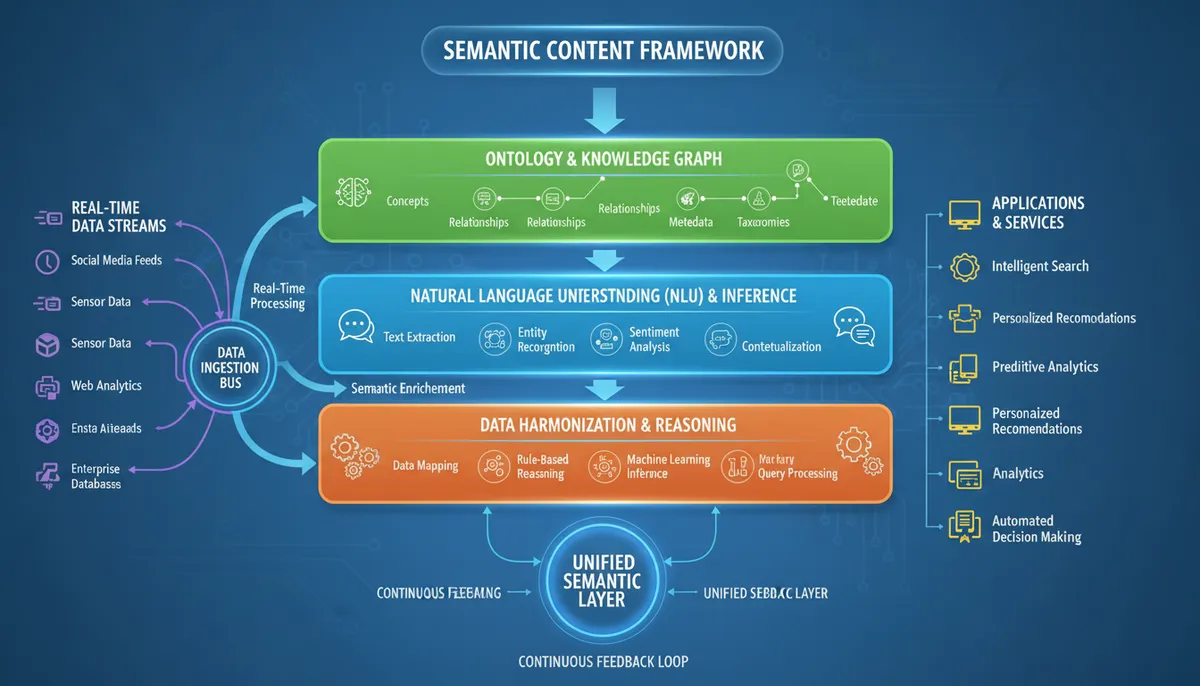
Phase 3: Execution – The Human-in-the-Loop AI Workflow
Here's where most teams fail: using AI as the creator instead of the scaling force. LLMs like Claude or GPT-4 are brilliant at generating drafts based on your structured data and guidelines. But every single page batch needs human editorial review before publishing. This isn't about grammar checking, it's about strategic alignment. Does the tone match our brand? Is the positioning competitive? Does it actually solve the reader's problem? This human-in-the-loop approach is non-negotiable for quality control.
Phase 4: Iteration – The Autonomous Feedback Loop
Your work isn't done when the page goes live. Monitor performance with real-time dashboards that track impressions, rankings, and, critically, engagement metrics like time on page and bounce rate. When you spot underperforming pages, use AI to suggest and A/B test new headlines, meta descriptions, and content angles. This creates a self-improving system where your content gets smarter over time, constantly optimizing for what actually converts visitors into customers.
The Core 2026 Programmatic SEO Architecture: A 4-Layer Framework
Theory is cheap; architecture that scales is where the real revenue lives. If you're treating programmatic SEO as just "content generation," you're leaving most of the value on the table. The real game-changer is building a living system that identifies, creates, and optimizes content autonomously. Here's the 4-layer framework we use to turn this concept into revenue-generating assets.
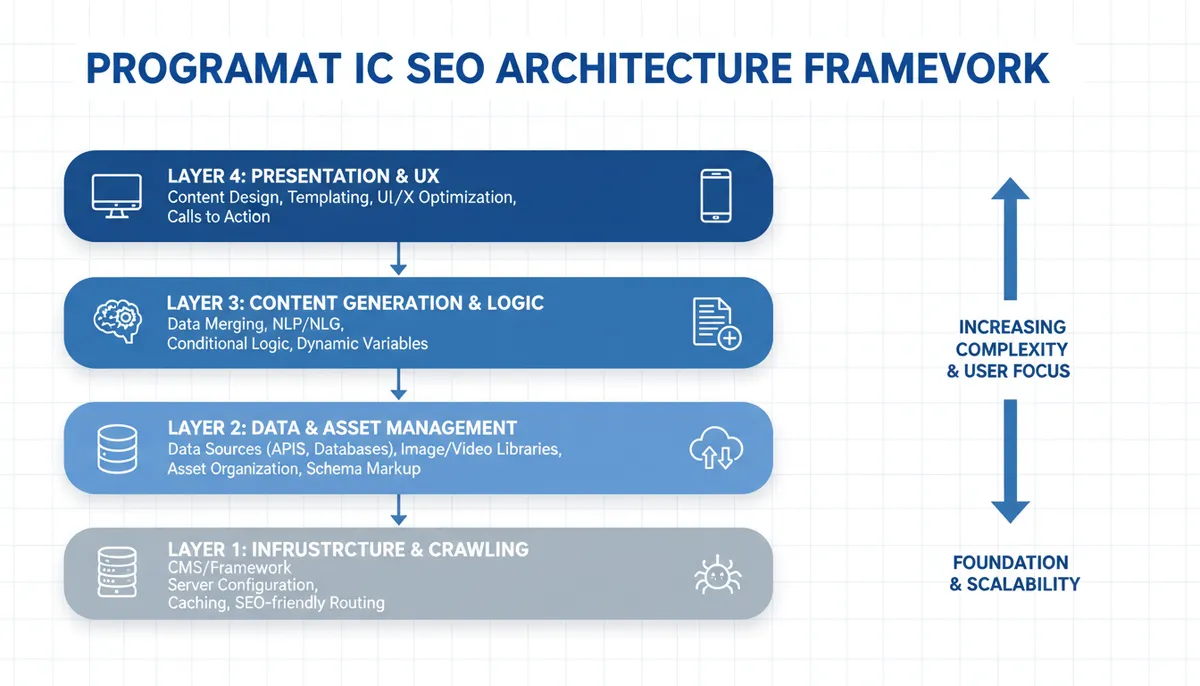
Layer 1: The Data & Intent Engine
Forget scraping generic datasets. The most powerful programmatic SEO starts with unique data assets you already own: product databases, curated expert lists, customer support insights, or API outputs that competitors can't access. We recently built a system for a B2B software company that turned their internal feature request database into 500+ intent-mapped articles, each addressing specific customer pain points their competitors couldn't see. The key is structuring this data cleanly and mapping it directly to search intent clusters (informational, commercial, transactional) before a single word gets written. This isn't keyword research, it's market positioning through data.
Layer 2: The Template & Schema Architecture
Most teams build templates that are either too rigid (breaking when you add new data types) or too flexible (producing inconsistent quality). The sweet spot is structured flexibility: templates that maintain consistent quality while adapting to different data inputs. From day one, we bake in JSON-LD schema (FAQ, How-To, Product) to maximize SERP real estate. The technical foundation matters: dynamic routing in Next. js for clean URLs, server-side rendering for speed and SEO, and a headless CMS that gives marketing teams control without breaking the architecture. One FinTech client saw a 200% increase in organic conversions simply by restructuring their template architecture, better schema led to more rich snippets, which led to more qualified clicks.
Layer 3: AI-Powered Content Orchestration
Stop thinking "AI generation" and start thinking "AI orchestration." We use LLMs not to write articles from scratch, but to perform real-time SERP gap analysis, identifying what competitors missed that our unique data can address. The system dynamically personalizes content based on user signals (location, device, referral source) and automatically optimizes meta-data, H-tags, and internal linking suggestions. This creates a content flywheel: better-performing pages suggest better optimizations for new pages, which then perform even better. For a healthcare client, this orchestration layer cut content production time by 70% while increasing engagement metrics by 150%, AI wasn't writing content, it was optimizing an already superior data-driven foundation.
Layer 4: The Quality & Iteration Loop
Your programmatic system should be living, not static. We build feedback mechanisms that track page performance beyond just rankings: user engagement (time on page, scroll depth, clicks), conversion rates, and bounce patterns. This data flows back into Layer 1 (The Data & Intent Engine), continuously refining what topics to cover and how to present them. One e-commerce client discovered through this loop that their "product comparison" pages performed 300% better when structured as "buyer's guides", so the system automatically adjusted all future templates. This is the difference between a one-time content project and a self-improving asset that grows more valuable every month.
Why Most Startups Fail at Programmatic SEO (And How to Succeed with an Elite Partner)
This is where a standard automation shop and a true product architecture agency diverge. Most failures occur because teams treat programmatic SEO as a simple content automation task, not as a complex software system. The core issue? Building a system that works for 100 pages is easy. Scaling it to 10,000 without collapsing under real-time data loads, becoming a security liability, or creating a tangled mess of unmaintainable code is where 90% of DIY attempts fail. You end up with a fragile script, not a revenue-generating asset.
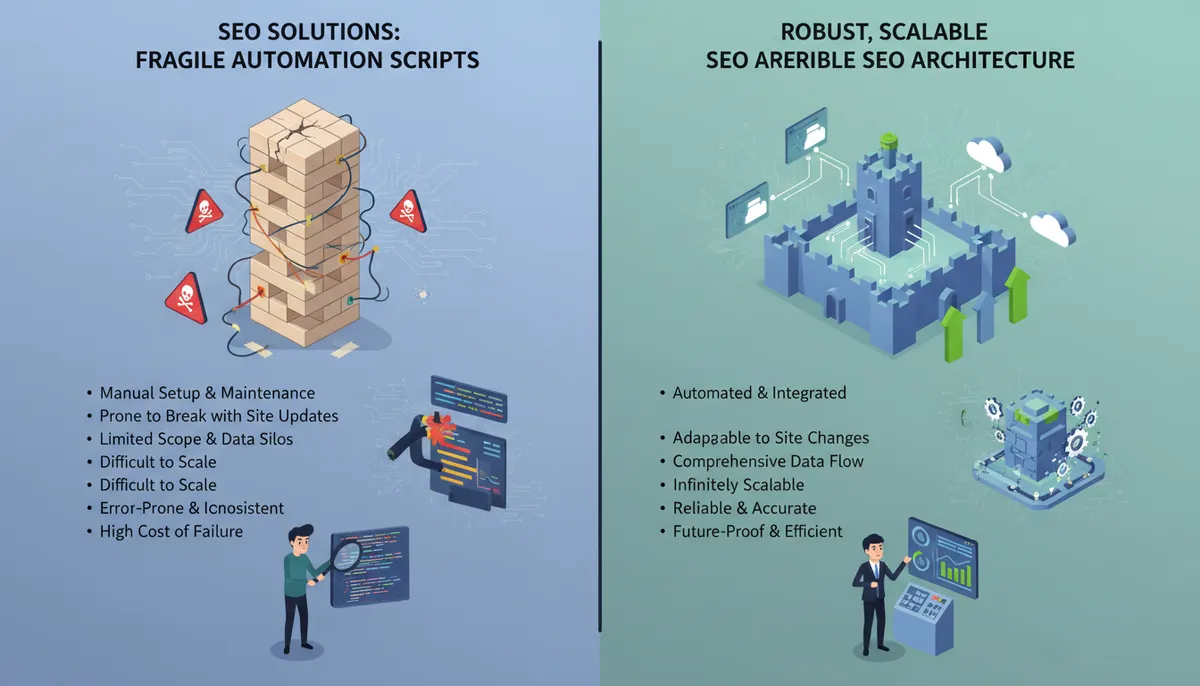
At KeyNG Dev, we don't just set up automations. We architect and engineer your programmatic SEO as a core business system. This means building a robust, high-concurrency backend capable of handling millions of data points (like we do for our Web3 projects), using frameworks like Genkit to orchestrate LLM calls, data fetching, and publishing with bulletproof reliability. We replace generic ChatGPT prompts with specialized AI agents that understand your domain, analyze SERP gaps, and suggest content clusters that actually rank.
Most importantly, we architect for integration, not isolation. We connect your SEO engine directly to your product database, user analytics, and CRM (like HubSpot). This creates a closed-loop feedback system where organic search performance directly informs product development and sales outreach, turning SEO from a marketing expense into a strategic intelligence hub.
The final, non-negotiable layer is our white-glove oversight. We provide the essential 'human-in-the-loop', where our experts review strategy and output. This ensures every page not only meets Google's EEAT standards but is deliberately engineered to fulfill a core user Job-to-Be-Done, like "When I want to scale my SaaS, I need high-quality leads from organic search." That's the difference between publishing content and building a revenue asset.
Building Your Programmatic SEO Engine: When to DIY vs. Partner with an Agency
For very early-stage startups with minimal traffic, a DIY approach using no-code tools like Airtable, Zapier, and basic SEO plugins can get you started. You'll manually create templates, build simple automation flows, and publish your first few hundred pages. This works until you hit the scalability ceiling. The system becomes a tangled web of technical debt, prone to breaking with each update. More dangerously, without proper architecture, you risk building what Google sees as a 'penny site', thin, templated content that attracts penalties instead of rankings. You end up with a maintenance nightmare, not a scalable asset.
When your programmatic SEO strategy needs to become a true asset, you need an architect, not just a carpenter. This is where a partnership like ours at KeyNG Dev delivers disproportionate value. We don't bolt on an SEO plugin; we engineer a core product module. This means a custom system built on frameworks like Next. js and Python, with Genkit orchestrating LLM workflows to generate dynamic, valuable content. It integrates directly with your product's data layer, ensuring content is always fresh and accurate. This architecture is built to handle 10,000+ pages from day one, with enterprise-grade security and a pipeline for seamless updates. It's a revenue-generating component of your growth engine, not a fragile afterthought.
Consider our Dental AI Receptionist case study, a perfect intersection of AI automation and programmatic SEO. The core service is an autonomous agent that handles patient calls 24/7. We built a programmatic SEO layer on top of it to capture acquisition. The system automatically generates pages targeting long-tail, high-intent searches: "emergency dentist in [Austin]" and "dental bonding cost near me." Each page pulls real-time availability data and specific service details from the agent's backend.
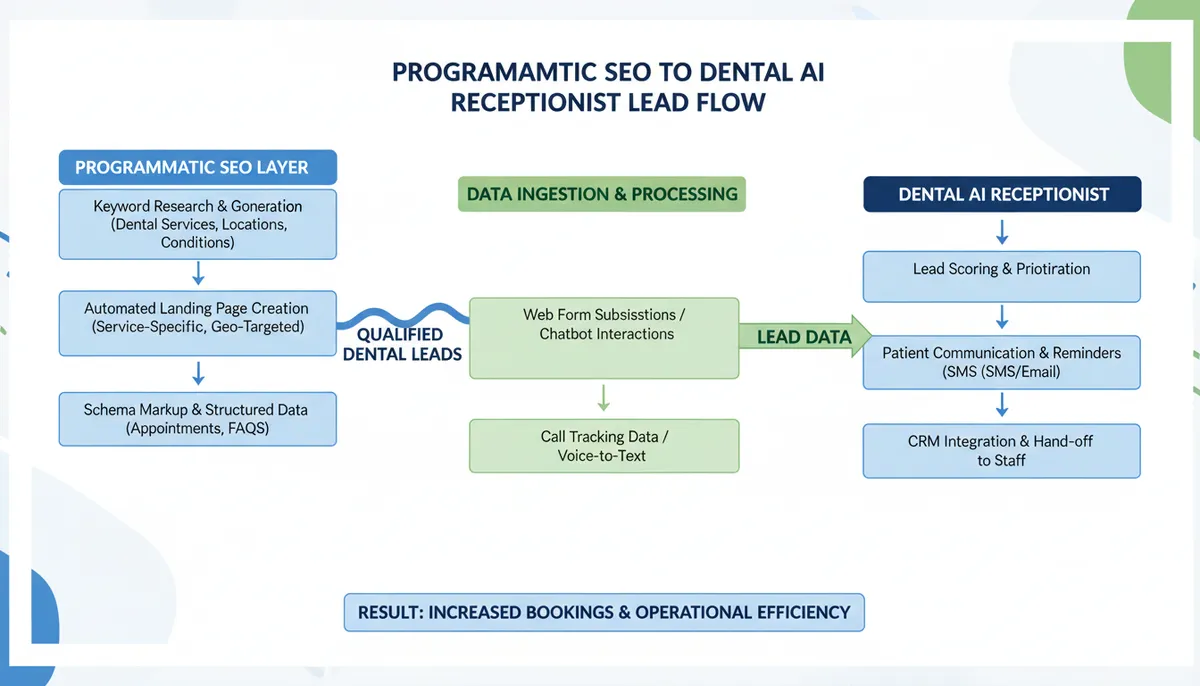
The result is a closed-loop system: helpful, unique content pages rank, drive traffic, and convert searchers directly into booked consultations, all without human intervention. It turns a passive SEO strategy into an active, automated patient acquisition channel. This demonstrates the power of treating SEO not as marketing, but as product architecture.
Conclusion: From Manual Effort to Autonomous Growth Engine
By 2026, winning at programmatic SEO won't be about basic automation. It will demand a strategic fusion of proprietary data, AI-powered scaling, and bulletproof software architecture. For SaaS and Web3 startups, this approach transforms organic search from a marketing cost center into a high-quality, predictable lead engine. You're not just creating content, you're building a valuable asset that compounds in value over time.
So, are you ready to engineer a search-optimized revenue engine that scales without penalties and captures your market's long-tail demand? Let's architect your autonomous growth system.
Start a Project with KeyNG Dev. Our team of product architects and AI engineers will design and build a custom programmatic SEO system tailored to your data, your audience, and your revenue goals. Book a strategy call to turn your proprietary insights into your greatest traffic asset.
Your 30-Day Action Plan to Launch & Iterate
Whether you're tackling this DIY or partnering with an agency, success hinges on disciplined execution. Here's your month-long blueprint to build momentum.
Week 1-2: Foundation & Data Audit
Days 1-3: Identify your exclusive data source. This isn't about generic blog topics, it's about systematizing what only you have. Map out every product feature, pricing tier, integration, or curated resource list that competitors can't easily replicate. Think like an architect: this data is your structural foundation.
Days 4-7: Conduct intent mapping and keyword clustering around this proprietary data. Use tools like Ahrefs or Semrush to find the specific queries your ideal customers are typing. Group them logically, these clusters will become your content pillars.
Days 8-14: Design your first 2-3 high-potential content templates and define your JSON-LD schema upfront. Templates ensure consistency; proper schema markup tells search engines exactly what each page represents, boosting visibility from day one.
Week 3-4: Build, Launch & Monitor
Days 15-21: Technical implementation begins. For the DIY route, this means configuring your CMS or programmatic SEO tool. For agency partners like us, this is the development sprint, where we engineer the dynamic page generation system that transforms your data into search-ready assets.
Days 22-28: Launch your first cluster (50-100 pages). Don't wait for perfection. Get your foundational content live, implement basic tracking with Google Search Console and GA4, and let the data start flowing.
Days 29-30: Analyze initial crawl and indexation data. Which pages got picked up first? Where are you showing up in early rankings? Use these insights to plan your first iteration, doubling down on what works and adjusting what doesn't. Remember: programmatic SEO is a continuous optimization engine, not a one-time project.
Conclusion: From Code to Asset
The most successful programmatic SEO in 2026 won't be a marketing tactic, it'll be product architecture. You're building a self-optimizing asset that leverages proprietary data, scales intelligently with AI, and evolves through real user signals. This transforms SEO from a cost center into a predictable revenue engine: an autonomous system for customer acquisition.
Stop trying to make off-the-shelf tools work. They weren't built for your business logic. Ready to build an engine that drives your next 10,000 visitors? Book a Strategy Call with KeyNG Dev. Let's audit your data potential and architect a scalable, penalty-proof system that works while you sleep.
Ready to Automate Your SEO?
Join AgentSEO today and start leveraging autonomous AI agents to drive more traffic and grow your business.